Table of Contents
Course Introduction
The goal of this course is to give you enough AI knowledge, skills, and experience - e.g., what LLMs are, how they work, Claude Code & MCPs and the like, skills & agents, etc. - so that you could look at what you do on a daily basis “with fresh eyes” so to speak, understand what you could be doing differently, and then start rebuilding your workflow - on both individual and team/company lvls.
In other words, to change the “how” in how you do your work; to start applying new methods to existing tasks. Inevitably though, you’ll end up thinking about changing the “what” too - that’s a natural consequence of learning new tools as a human. We’ll play with that too. For example, instead of drafting social media posts or emails with AI (changing the how), you’ll be designing and guiding an agent that does this for you and only reports back with updates (changing the what).
Here’s a 2x2 matrix to illustrate this idea:
| Existing tasks | New tasks | |
|---|---|---|
| Existing methods | Most teams today | … |
| New methods | Very few teams today — you very soon! | Teams of tomorrow — you in not-too-distant future! |
How this course works
- Small groups of 10–15 students
- Instructors who both know their subject deeply and love teaching (rare find!)
- Structured, curated, up-to-date curriculum
- Lots of live work and support: 1:1s, office hours, group calls
- Evidence-based learning techniques like active recall, Socratic questioning, etc.
Syllabus
So what is it exactly that you’re going to learn?
Think of learning tennis. When you’re just starting out, you’re officially “a novice.” So you learn the novice things first: how to hold a racket, how to move, how to hit a certain area of the field, etc.
Then you graduate to being “a beginner.” How do you know that you’re a beginner? Again, there’s qualifications that help you tell, and there’s a structured learning path that helps you understand what exactly you should be learning at each level. In other words, over centuries (tennis is 900 years old btw!), humans have formalized and codified the learning of tennis, and then perfected the learning path over and over again - so in 2026 learning tennis is waaaay more efficient than it was in 1,176.
It’s wild that we don’t have this for AI. So we decided to do it and came up with this table of “AI fluency.” Throughout the course, you’re going to go through these stages one by one, and by the end of 4 weeks you’ll reach Intermediate/Advanced. (If you’re not a novice already, you’ll start at a different stage; your course instructor will help you figure this out.)
| Stage | Level | Who you are to AI | What you can do | Concepts | Mental model |
|---|---|---|---|---|---|
| 1 | Novice | The Doer | Use ChatGPT/Claude as a smarter search. One-shot questions, no context. Output is generic because input is generic. | Chat (prompt → response) | "AI is a smarter Google." |
| 2 | Beginner | The Teacher | Build context files (about-me, about-company, voice, examples). The same prompt now produces better output because it has your specific context. | What LLMs are (memory, context), AI tool ecosystem | "AI is a new hire I have to onboard." |
| 3 | Intermediate | The Builder | Package repeated prompts into skills. Slash commands. MCPs and CLI tools. Scheduled tasks running. Comfortable using coding agents. | Skills, MCPs, CLIs, plugins, planning, context management | "AI is a teammate who learned the playbook." |
| 4 | Advanced | The Orchestrator | Build agents that run with goals. They read your inbox, draft responses, manage todos, ingest call notes. You stay in the loop (you orchestrate), but they do most of the work. | Automations, agents, systems thinking | "AI is a junior employee who works while I sleep." |
| 5 | Expert | The Observer | Design multi-agent systems for the team. Meta-agents: housekeeping, governance, observability. Think about agent fleets the way an engineering manager thinks about teams. | Systems thinking, building agent layer for your team | "AI is the operations layer of our company." |
The 4-week syllabus through the POV of AI skills progression
Week 1: LLM Foundations + First Taste of Claude Cowork
- Lecture: LLM architecture and training pipeline (base → assistant → reasoning), LLM psychology and shortcomings, the shift from prompt to context to harness engineering
- Workshop: AI tool ecosystem overview, walk through Chat → Cowork → Code, start the CRM with Cowork + Brain (daily run reviews emails and transcripts, defines "relationship," writes to Brain)
- Assignments: download Claude desktop, audit 10–15 "leaky bucket" areas in your day, set up Cowork connectors and computer use, ship your first scheduled task
- Tools: Claude desktop app, focus on Cowork
- AI fluency: From Stage 1 to Stage 2
Week 2: Claude Code Deep Dive + Personal OS Creation
- Lecture: CLAUDE.md (global vs project), context engineering, codebase comprehension, subagents, parallel agents, extending Claude Code with MCP servers and CLI tools, auth, databases, storage, cron, APIs
- Workshop: terminal setup and Claude Code install, extend the CRM to research blank "About" columns, pull LinkedIn, log last conversation topic and date
- Assignments: complete the Claude Code repo exercise (build a skill, connect an MCP, spin up parallel agents), use the interview tool to build out About Me / About My Work / Writing Rules files, run a Claude Code + Brain exercise on a workflow from your audit
- Tools: Terminal, VS Code, Claude Code, Brain
- AI fluency: Stage 3
Week 3: Agents, Assistants, and Workflows
- Lecture: the autonomy continuum (agents vs assistants vs workflows), agent architecture (loops, tool calling, function calling), self-improvement loops
- Workshop: deploy parallel agents to update CRM columns, two agents performing distinct CRM tasks
- Assignments: walk through the repo for assistants (system prompt), workflows (system prompt + deterministic flow), and agent teams (orchestrator + specialized agents, non-deterministic flow); build one or two agents for workflows from your audit
- Tools: Claude Code, Brain
- AI fluency: Stage 4
Week 4: From Individual to Team Use of AI + Building a Team Brain
- Lecture: building for yourself vs building for teams, sharing knowledge, skills, and instructions across a function, tracking what others are building, quality bar, avoiding duplication, creating a living model of how an organization reasons, remembers, and behaves
- Workshop: evolve the CRM from individual to team. Handle shared memory, permissions, attribution, deduplication, who owns what, whose transcript or context wins, what stays personal vs shared
- Assignments: take one workflow from your audit and plan how a team contributes to it
- Demo Day: every student demos 2–3 AI workflows they rethought and rebuilt from their Week 1 audit
- Tools: Claude Code, Brain
- AI fluency: Stage 4, conceptually moving to Stage 5
Here’s a full syllabus if you’re curious.
Why Claude Code & Brain combo?
Claude Code is a no-brainer at this point (pun intended!). It’s a powerful coding agent and gives you way more control & nuance than the higher-level AI tools like Notion AI, etc.
As for Brain, we see it as a unique kind of software - software that you build as much as use. Think of this like furniture in your house. Most software is like fully-furnished flats: you come in, it’s already got everything you might need, and you just start using it like that, living in it. Brain is like a lot of land that you just purchased. You can construct any sort of building there, and then furnish it however you like. You build it as much as use it - and that’s what makes it so powerful
Course Vibes
Here's some screenshots from a similar course we ran previously, so you get a better idea how it feels to study with us:
Inside the Course:What Your Week Looks Like
Kickoff Call
Meet your cohort, get set up, and dive into your first audit

Cohort kickoff — getting to know each other
Guest Speaker Sessions
Learn from practitioners building with AI at the frontier

Inspiring world-class experts share how they actually work with AI
Office Hours
Plus 1:1 time to unblock you on your specific workflows

Weekly group office hours with your instructors
Demo Day
The capstone — show what you built and how the way you work has changed

Every student demos 2–3 AI workflows they rebuilt from scratch
Outcomes
By the end of this 4-week course you can expect to:
- A good understanding of AI fundamentals: what LLMs are, how they work, how they’re built, where they’re fundamentally limited
- Your personal and team AI stack set-up: your coding agent, your agent for working with files, your personal OS, your team workspace via Brain, etc.
- ~10 custom workflows that you built for yourself and your team (e.g. daily standup, automated CRM, automated call actions)
- 2-3 agents that you created
- Brain workspace setup for your team, with the right primitives in place and AI layer configured - from skills to agents
Student Reviews
Here's some reviews that we've had for a similar course we've been running for ~6 months already:
-
"Half my team has done this now and I'm going to make it mandatory for non-technical folks as it's elevated our product and technical convos. Strong recommend." — Juan Andrade, Founder, Caribou (YC W19)
-
"As a generalist founder, I've been wanting to develop the capacity to autonomously build software and collaborate with my technical team at Cuanto. I joined the first cohort of the Vibe Coding Foundations course at AI Study Camp and I feel I obtained a new superpower in just 5 weeks: I can build software. The curriculum put together by Vasili Shynkarenka and Nicole Garcia Fischer was absolutely fantastic. If you are looking for a qualitative step-function change rather than incremental learning, check them out!" — Felipe Echandi, Co-founder & CEO at Cuanto (YC W19)
-
"I started this program with AI anxiety and finished with AI optimism — a shipped product that real users are testing. As a consultant, I always felt the gap between what surveys measure and what people actually mean, so I built an AI research tool that gives you interview depth at survey scale. I learned the stack, got comfortable in the terminal, and built it myself. Bonus: no developer required!" — David Samudio, Experience Design, Banistmo
You can browse more reviews here.
Instructors
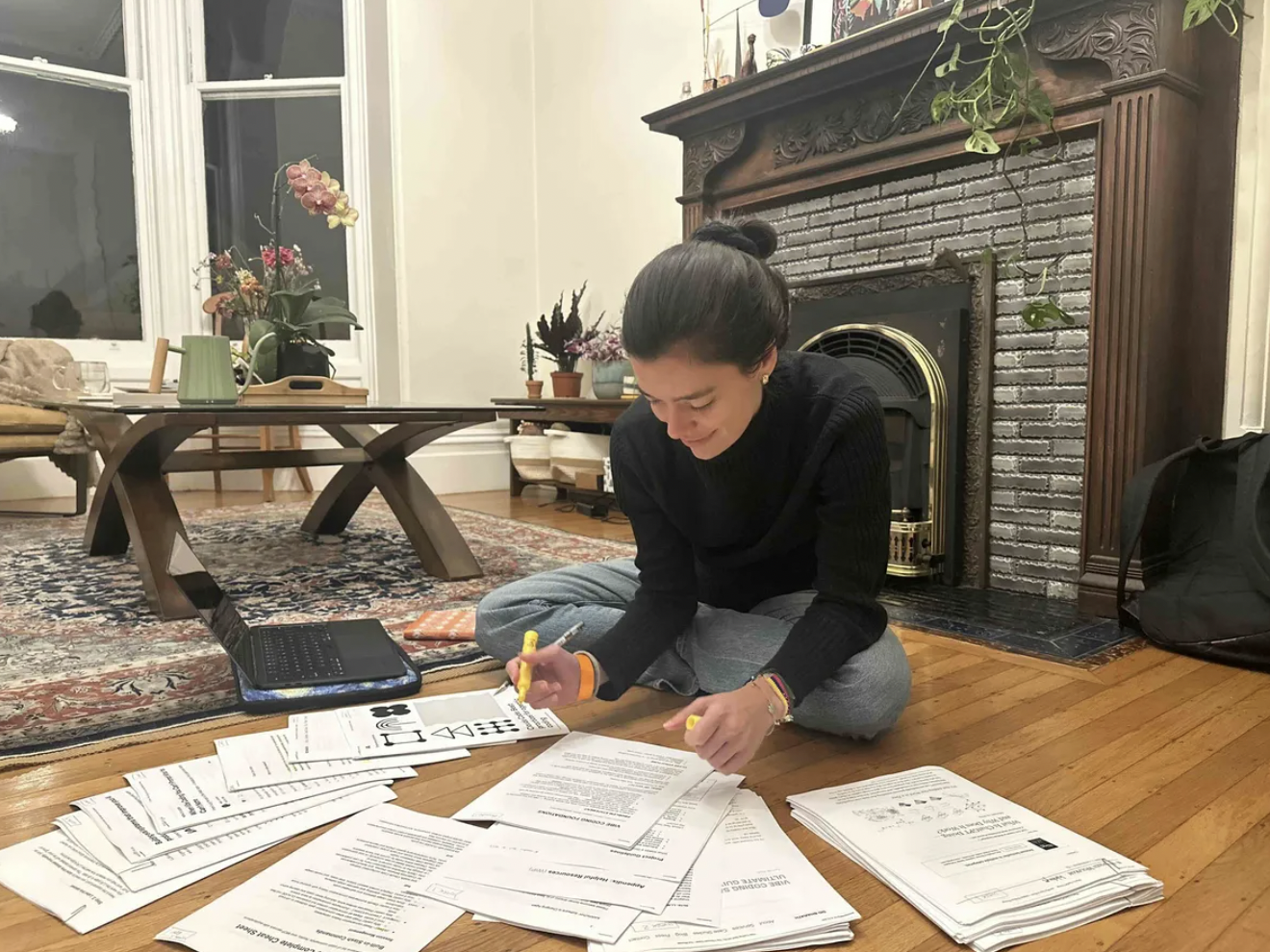
Nicole Garcia Fischer — Main Instructor
Co-founder of AI Study Camp. Created AISC's Vibe Coding Foundations course, taught to 50+ YC founders. 7-year bizops background; built 0-to-1 processes for a 2,000-person company. Duke graduate. Focus: vibe coding.
Vasili Shynkarenka — Co-Instructor

In SF with Cathy Pearl, ex Design Manager of Google Assistant at Google
Founded AI Study Camp in 2025, with the goal of helping people really understand AI. Built a software agency BotCube in ~2016-2018, creating chatbots for large enterprises. YC founder with Storyline W18 (no-code Alexa skills builder).Teaching LLMs since late 2020.
Pricing
$3,500 per person, with a 20% discount if you bring in more than one person from your team.
How to Sign Up
Fill in this form and we'll be in touch in <24 hours.
Let's do this!